
ONE SHOT DEAL - CHICAGO '78 - HALLOWEEN: LIVE COMPILATIONS #1 AND XENOCHRONY
ONE SHOT DEAL
 During the European winter tour of 1978 Zappa recorded most of the live tracks for "Sheik Yerbouti" during the five
concerts he held at the Odeon Hammersmith in London. Touring continued on the continent. At least two concerts in Germany got
filmed for TV, so you might here have a possibility for a DVD, for instance combined with the bands appearance at the Saturday
Night Live show (see also the Live recordings section of the left menu). To the right: FZ and Arthur Barrow during
the Ulm open air concert, summer 1978 (German TV registration).
During the European winter tour of 1978 Zappa recorded most of the live tracks for "Sheik Yerbouti" during the five
concerts he held at the Odeon Hammersmith in London. Touring continued on the continent. At least two concerts in Germany got
filmed for TV, so you might here have a possibility for a DVD, for instance combined with the bands appearance at the Saturday
Night Live show (see also the Live recordings section of the left menu). To the right: FZ and Arthur Barrow during
the Ulm open air concert, summer 1978 (German TV registration).
Heidelberg
More teasing is what Zappa says about the "Heidelberg" solo, namely that it's not the best of its kind, but that he liked
this one because of the crowd noises responding to the solo. Another pro of this solo is the interaction with the keyboard
player. "Heidelberg" premiered on the 1987 promotional cassette "The guitar world according to Frank Zappa" and got
included in the "One shot deal" CD by the ZFT. It's a smaller cross through selection from the live archive,
one of the by now twenty releases by the ZFT that are made up of live recordings. The ZFT succeeds rather well
in filling up gaps that were left by Zappa himself. The kind of solo Zappa is referring to is a solo in E Mixolydian,
starting over a sustained E pedal note without drumming. The "Mo' mama" and "Yo' mama" solos from the previous section are two other examples.
"Why Johnny can't read" from February 1979 is a fourth example, recorded several months later, so there could very well exist a whole series of solos
of this type in the archives.
Other than "Why Johnny can't read", "Heidelberg" resembles "Yo' mama" in some of its phrases. Its set up is different however in the
sense that it doesn't evolve into a chord alternation, but into strict 4/4 over a bass playing just the E on beat. First
Zappa sets the meter to 4/4 himself with his guitar rhythm. Next the drummer joins in, followed by the bass. The section
below from 2:13 to 3:04 includes this transition from playing without meter to everybody playing in 4/4.
The solo at the end returns to the sustained E pedal note without drumming.
Zappa himself started listening systematically to the tapes for guitar solos from 1979 onwards for the three guitar collections
on CD. It's a tempting thought what could have been done if he would have had the time going back in time picking out the
best solos by himself, or maybe by Steve Vai or Dweezil Zappa.
Heidelberg, 2:13-3:04 (midi file).
Heidelberg, 2:13-3:04 (transcription).
Hiring studios for finishing the album had become expensive and studios had to
be booked months in advance. So Zappa decided
that it was more economical to build a studio of his own at his house in L.A. It was completed
during the fall of 1978,
when he had set up his own record company Zappa Records (later Barking Pumpkin Records).
He also had made a deal with the Indian born violist "L." (Lakshmirnarayna) Shankar. He produced Shankar's album "Touch me there" for his
new company
and co-wrote
four songs with him for the album (see the next section for more about this record). Shankar made a guest
appearance during the concerts around Halloween of October 1978 (See the "You can't..." section for "Thirteen"). By that time the two lead singers next to Zappa on "Sheik Yerbouti", Terry Bozzio
and Adrian Belew, had left the band. Terry had now worked with Zappa for four years and needed a change, his name
forever being associated with beating "The black page". Adrian accepted an offer
by David Bowie, but later considered changing this fast a juvenile mistake. Zappa normally accepted band members leaving without ill feelings
and didn't try to convince them to stay. Terry was replaced by Vince Colaiuta and Adrian by Denny Walley.
The Zappa Family Trust compiled an audio DVD from the concerts as "Halloween 1978", released in 2005. The touring program by now included various unreleased
material under development that would appear on record over the period 1979-1982.
XENOCHRONY
Via interviews with Zappa it has been known for long that the solos for "Joe's garage" (1979, next section) were recorded live. He separated the guitar parts from the tracks and added new accompaniments to them via a method that he called xenochrony. The term stands for combining two tracks, that were recorded separately, in such a manner that they respond to each other. The earliest example on record, "Friendly little finger", has already been dealt with in the "Zoot allures" section. In order to achieve this you need a velocity control regulator (VCR), a device that can change the tempo without affecting the pitch. This way you can manage that both tracks can be both on beat at several instances, so that it looks as if they were recorded at the same time. In fact, if Zappa hadn't informed us about when he applied xenochrony, we would never know. "Ya Hozna" from 1984 is one of the few exceptions, because on this occasion, you can deduce it yourself that this must have happened. See the Them or us section for the details.
Occam's razor - On the bus
With the ZFT release "One shot deal" however, we get to hear the original "Occam's razor" solo, parts of which
became "On the bus" from "Joe's garage" via xenochrony. I never understood why Zappa chose for this labour intensive
method on "Joe's garage". He adapted the sound of the guitar to be in line with the sound of the other tracks from
this album, so probably that would have been possible with the live accompaniment as well. Secondly, if he wanted
a different accompaniment nevertheless, then why not overdub it (you could have someone conducting listening to the old
accompaniment on a headphone and let the band do a new accompaniment, exactly in pace). Comparing "Occam's razor" with "On the bus" gives
an inside the kitchen opportunity to look at the process. It explains in my opinion why Zappa chose for xenochrony:
it is not so much he wanted to manipulate the accompaniment, he wanted to be able to manipulate the solo itself
completely at will as shown below via two corresponding sections. "On the bus" starts with the guitar line from the
"Occam's razor" solo at 0:17 on the "One shot deal" CD.
Occam's razor, 0:17 till 0:55 (midi file).
On the bus, 0:00 till 0:33 (midi file).
Occam's razor, 0:17 till 0:55 (transcription).
On the bus, 0:00 till 0:33 (transcription).
For the next section I'm taking "Occam's razor" as the basis and I'll comment upon the main differences that can be found in
"On the bus".
- Most obvious to notice is the different accompaniment. "Occam's razor" belongs to the series of C Lydian solos Zappa
played during the 1979 tour of which four of them landed on "Shut up 'n play yer guitar" (see the corresponding section). Here you actually get to hear
the transition to one of the written themes of "Inca roads". "On the bus" has a one-bar vamp-like bass pattern with A as a pedal note,
so this one is in A Dorian.
- The tempo of the accompaniment from "On the bus" is slightly slower. Just for that you'd need some speed adaptation for
the solo.
- During bars 1-5 there are minor tempo differences. The figure starting with G in bar 2 starts about a 16th note later
and ends earlier with the high F# in bar 3, so here Zappa accelerated "On the bus" a little. By the way, transcriptions
like this or in the Guitar book aren't done with a mathematical precision that you could get by measuring the pitch lengths
physically. They are good approximations of what a human ear can distinguish. There's no point in notating rhythms
with more precision than you can hear.
- At beat 1 of bar 6 you get at a more serious tempo difference. "On the bus" gets almost an 8th note ahead.
- At the end of bar 6 you can see that Zappa started editing the "Occam's razor" solo. The whole block A is missing
and it's not exactly one bar's length. So this is the sort of manipulating the solo at will.
- At bar 8, starting with the chord, "On the bus" is on beat, just as "Occam's razor", that is now one bar behind. So here Zappa
used xenochrony to get "On the bus" parallel again.
- In bar 11 the whole block B gets skipped. Next the solos are about parallel for a bar and a half.
- In bar 13 block C is removed. "On the bus" is now up to three bars ahead. Both solos return to the opening lick, now
with the A sustained for some bars.
Remains the question why Zappa picked those three blocks from "Occam's razor" to skip from "On the bus". "Occam's razor"
has movements with rapid sequences, sustained notes and movements in between. The three blocks are in between. I think Zappa
wanted "On the bus" to be a more articulated solo regarding changes, whereas "Occam's razor" is more relaxed. It must also
have been that he enjoyed this type of work, sitting for hours in a studio editing tapes. On "Friendly little finger" and "Rubber shirt" you could call xenochrony
an experiment exploring the possibilities of this technique. On "Joe's garage" it's done extensively and systematically. Any
"normal" producer would have settled for "Joe's garage" as a double album instead of a three-record set.
A second instance, where you can check the working of xenochrony, is present in the next Joe's garage section at
"Keep it greasy". On this occasion Zappa took a live solo from "Outside now", in 11/8, to superimpose
it over a vamp in 19/16. Combined with things as happening during "Rubber shirt", it demonstrates the almost unlimited possibilities of xenochrony
for combining unrelated seperately recorded tracks.
Zappa's most extensive comment upon xenochrony can be found in the liner notes of "The guitar world according to Frank Zappa" cassette. It's included as
comment upon "Friendly little finger":
"Friendly little finger" (04:17); 1975, recorded in a dressing room at Hofstra University and over-dubbed at the Record Plant, Los Angeles, California;
originally released on the Warner Brothers album "Zoot allures"; engineer: Davey Moire;
original recording medium: 24-track analog tape; musicians: Frank Zappa, various guitars and bass/Ruth Underwood, percussion & ARP 2600/Roy Estrada, drone bass/Terry Bozzio, drums;
guitars: Gibson acoustic-electric, Custom fretless, Hofner bass.
This is one of the earliest examples of a technique I developed called xenochrony (strange synchronizations).
Other examples include "Rubber shirt" on "Sheik yerbouti" and every guitar solo on "Joe's garage" except "Watermelon in Easter hay".
In this technique various tracks from unrelated sources are randomly synchronized with each other to make a final
composition with rhythmic relationships unachievable by other means. In ordinary polyrhythmic terms we speak of 5 in the space of 4, or 7 in the space of 6.
In xenochrony we deal with larger units of time; a complete solo at one metronomic rate in the space of a track at another ... sort of like Monday and Tuesday
crammed into the space of Wednesday. The solo and drone bass was recorded on a 2-track Nagra, 15 ips, with a pair of Neumann U-87
microphones in a rather wet-sounding dressing room, warming up before a concert at Hofstra University on Long Island.
This pair of tracks was later xenochronized to a drum track out-take from "The ocean is the ultimate solution".
The introductory orchestration was added next, and then the Hofner bass (recorded at half-speed), rhythmically splitting the difference between the two different track tempos."
CHICAGO '78
 One instance of where the ZFT jumped in effectively in filling in gaps are the "Chicago '78" CD and the "Halloween" audio DVD.
Zappa himself used relatively little from
his 1978 fall tour for his albums. As more often with live concerts, version differences and guitar solos are making "Chicago '78"
an interesting album. "Twenty-one" is a guitar solo, played as the concert opener. "Village of the sun" features Ike Willis on vocals.
This version includes a guitar solo. "Yo' mama" can be heard without the studio overdubs. At some points it's more sober regarding the
keyboard and vocals parts, but this doesn't affect the strength of the guitar solo. The general outlines, as sketched in the Sheik Yerbouti section,
are followed again, but the solo functions very well as a composition upon its own merits.
"Little house I used to live in" gives the band members room to improvise.
One instance of where the ZFT jumped in effectively in filling in gaps are the "Chicago '78" CD and the "Halloween" audio DVD.
Zappa himself used relatively little from
his 1978 fall tour for his albums. As more often with live concerts, version differences and guitar solos are making "Chicago '78"
an interesting album. "Twenty-one" is a guitar solo, played as the concert opener. "Village of the sun" features Ike Willis on vocals.
This version includes a guitar solo. "Yo' mama" can be heard without the studio overdubs. At some points it's more sober regarding the
keyboard and vocals parts, but this doesn't affect the strength of the guitar solo. The general outlines, as sketched in the Sheik Yerbouti section,
are followed again, but the solo functions very well as a composition upon its own merits.
"Little house I used to live in" gives the band members room to improvise.
Twenty-one
"Twenty-one" was used as a concert opener with Zappa playing over a vamp that lasts twenty-one eighth notes in total,
quite obviously being the reason for its title.
The vamp can be subdivided into two bars, one in 9/8, the other in 12/8. It gets played in two variants. One
with the first note of the 9/8 bar being a C, the other with this first note being a higher Eb. The switch is made
every four bars.
Twenty-one, 0:00-0:34 (midi file).
Twenty-one, 0:00-0:34 (transcription).
During this solo, this composition modulates one time by transposing the vamp up with a major second:
- 0:00 The vamp begins in C Dorian.
- 0:22 Zappa starts soloing over it.
- 2:56 He sustains his last note, the vamp modulates to D Dorian.
- 3:17 He restarts soloing.
- 6:15 The soloing ends with the vamp continuing.
- 6:31 Zappa introduces the show, the vamp moves to the background.
- 8:25 End.
The vamp of "Twenty-one" returned during the 1988 tour with Zappa playing a solo over it,
that became the title track of his "Trance-fusion" CD. See the corresponding section for an extract from this solo.
Paroxysmal splendor
During "Paroxysmal splendor" you can hear unreleased components, while material from other songs can be recognized as well.
It's made up of the following blocks:
- 0:00 Opening bars from "Greggery Peccary". See the Orchestral favorites section for the score.
- 0:27 "FZ & pig". Ballroom music. You can hear the crowd cheering, so there must actually be some dancing taking place.
Maybe a coincidence, but it fits in well with the classical decorum of the Uptown Theater from Chicago, a city known for
its combination of classical and modern architecture (photos below).
It's stereotype music, but I know too little of dances to comment upon the style. It's in C and in 4/4. It's begins with a
repeated cadence like G-B-C movement, coming at rest upon C.
The example below begins with the second theme from this dance, starting at 1:05. It's played only once. It's following a chord
progression with a frequent use of altered notes. The basic pattern is F-Fm-C-Em-C-GM7-G, used with
a lot of liberty, enlarging the chords by adding in extra notes. At 1:24 the opening movement recommences.
Paroxysmal splendor, 1:05-1:30 (midi file).
Paroxysmal splendor, 1:05-1:30 (transcription).
In September 2020 Fabrizio Mencarelli informed me that this episode is based upon "Cerisier rose et pommier blanc" (cherry pink and apple blossom white)
with its music written in 1950 by Louis Guglielmi. The type of dance would be a "cha-cha-cha".
- 2:00 Guitar solo, using one of the riffs from the later "I'm a beautiful guy" song as a vamp.
- 3:34 Variation upon "Ship ahoy" (see the Läther section for an example from "Ship ahoy" as how it landed on "Läther").
- 4:26 "Ten years later". Straightforward rock music and soloing in A Dorian/Mixolydian. This section is included to show
that Zappa could do anything. As he had looked for deliberate simplicity in doo-wop on "Cruising with Ruben and the Jets",
you can also encounter bars in other styles, played in a basic stereotype manner. Bars 1-3 contain the A chord pulsing in a 24/16 meter, interrupted
only once by a D chord at the end of a bar.
These are bars of eighth ticks, split into three. The standard rock meter is 4/4, so one might also choose to notate this in 4/4 with
four beats made up of two triplets each. The ensuing soloing fluctuates between Dorian and Mixolydian by using both C natural and C sharp, a recurrent
practice in Zappa's music.
Paroxysmal splendor, 4:39-4:51 (midi file).
Paroxysmal splendor, 4:39-4:51 (transcription).
- 5:30 This soloing moves over into an early live performance of "Crew slut". This song would first be released
in a studio version on "Joe's garage". Here it's a raw basic version
without the characteristic accompanying figure from "Joe's garage".
- 6:02 The soloing in A Dorian/Mixolydian continues as an outro.
- 7:07 Zappa ending with saying "now that was just make belief, we were just pretending".
- 7:13 End.


Entrance hall of the Uptown Theater in the seventies, where the "Chicago '78" venue took place (photographer unknown). This hall was opened in 1925
as the biggest movie theatre in the U.S. It's located at Broadway, north of the city center (photo KS, ca. 1992). During the seventies it served
as a concert hall with Zappa playing in it during his 1977-1980 tours (above an outtake from the CD's inner sleeve photo with FZ, Denny Walley
and Peter Wolf). In 1981
it closed for regular use and got into decay. Plans exist to restore the hall.
Yo' mama (Chicago '78)
The Chicago '78 version of "Yo' mama" let's you hear how this song sounded live without the overdubs. It uses
the same structure as the Sheik Yerbouti version of the piece (see "Yo' mama (London)"
from the corresponding section from this study). Regarding the sung part there are no significant differences. The solo, on the
other hand, is strong. Specifically the part over the sustained bass pedal sounds entirely new.
Yo' mama (Chicago '78), 2:33-2:51 (midi file).
Yo' mama (Chicago '78), 4:39-4:59 (midi file).
Yo' mama (Chicago '78), 2:33-2:51 (transcription).
Yo' mama (Chicago '78), 4:39-4:59 (transcription).
The first example from above is from the opening block of this solo, when there's no drum part. Zappa is playing without
a meter. It contains a chord progression: E-Dsus2-E, followed by a quartal chord (A-D-G, two stacked fourths).
This last chord gets accentuated and returns a couple of times. It's an altered chord, using a G natural, which
makes it sound so sharp in the Mixolydian context of this solo.
One might also interpret this as another example of mingling of Mixolydian and Dorian. The keyboard
harmonies during the second E chord extend the harmonies to E11. This also goes for much of the second example, where the drummer has
entered the picture. I've included the drum part on this occasion, otherwise the meter notation with 4/4 and one time 5/4 couldn't be followed.
Zappa himself may be playing chords of two notes, but the E pedal and keyboard part make the overall harmony sound much wider.
HALLOWEEN, 1978
Three titles from the Halloween concerts appeared on YCDTOSA Vol. IV and VI (see the YCDTOSA section #1 for "Thirteen"). For their "Halloween" audio DVD the Zappa Family Trust chose the part of the program that was basically the same as the year before plus two individual solos: the concert opener "Ancient armaments" with Zappa on guitar and "Zeets" featuring Vince Colaiuta. Instead of doing an early and a late show on Halloween night, this year he chose for an exceptionally long concert of four hours. He introduces this now legendary concert as "All right this is the big one, [...]. Since this is the big one, we're gonna do an extra long show. I hope you don't have to leave early". In 2025 UMG released this concert in its entirety as "Halloween 78", combined with the concert from October 27th, while Joe Travers mentions plans to release the other four Halloween concerts from 1978 as well.
Ancient armanents - 10-27-78 Show 1 opening
The ZFT DVD represents 70 minutes taken from this gig. The concert opener was a guitar solo in A Dorian in 3/4, called "Ancient
armaments". It's an example of Zappa playing a solo independently, instead of forming part of a song. The concert ended with
another big solo, played separately, namely a mix of "Black napkins" and "The deathless horsie" with Shankar on violin.
The other two solos on "Halloween" are played during "Easy meat" and "Stinkfoot".
Ancient armanents, opening (midi file).
Ancient armanents, opening (transcription).
"Ancient armaments" has been released before as the b-side of the 1980 "I don't wanna get drafted" single. The crowd is much
enthusiastic and Zappa waits for about three minutes to let things settle down and accelerate his soloing. The accompaniment
first plays solo for a couple of bars, next Zappa joins in with some sustained notes.
10-27-78 Show 1 opening, 1:42-2:03 (midi file).
10-27-78 Show 1 opening, 1:42-2:03 (transcription).
The 2025 UMG release "Halloween '78" also contains the opening of the early show of October 27th. This edition
has the CDs and comments contained in an item that has the shape of a book, on its turn included in a box with a Halloween mask,
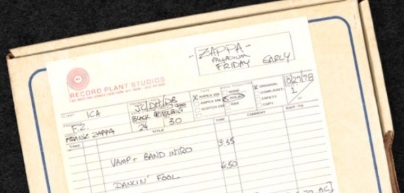
as also the preceding ZFT Halloween editions had. On one page you see that on the tape box Zappa described this opening as
"Vamp + Band intro" (the image above is an outtake). On the CD it carries the title "10-27-78 Show 1 opening". On this occasion
Zappa started the show with playing guitar. This time also in A Dorian, but in 4/4 and indeed over a vamp. So far this is the only
officially released example of him opening a show in this manner. Roughly it goes as:
- 0:00 tuning up.
- 1:16 the bass begins playing the vamp.
- 1:42 begin of the guitar solo, of which the first five bars are shown in the example from above.
- 3:15 end of the solo, the band continues vamping.
- 3:32 greeting and introductions.
- 4:29 end.
Stinkfoot (1974-78)
"Stinkfoot" exists in three variants. One is the original studio recording for "Apostrophe (')", the second is a live variant,
today available in four versions. The live variant follows the thematic architecture of the studio version, but has a
much different main vamp. Both bass lines of the vamp are in 12/8 and follow the C Mixolydian scale. As for their notes
and chords, they have about nothing in common. The live version has a C and B chord alternating. For the studio variant
you have various people playing freely through the C Dorian scale (that has an Eb compared to the E natural of the bass).
All versions contain a solo, making each one of them worthwhile. There can be stage happenings as well. The 1988 track has
an intro about Jimmy Swaggart being caught with a prostitute. During the 1978 performance Zappa recognizes an old
acquaintance in the audience from the Garrick theatre concerts a decade before, a guy who then came on stage every night.
The live variant of the vamp also got used for accompanying Zappa's "Poodle lecture", as you can find it on "YCDTOSA Vol. VI",
as well as in the "Baby snakes" movie. See the Baby snakes section for the opening bars.
A third variant of "Stinkfoot" turned up with the ZFT release "Zappa '75 Zagreb/Ljubljana" from 2022.
An example from that specific 1975 performance is included in the FZ:OZ section of this study.
Stinkfoot (1978 live), opening bars (midi file).
Stinkfoot (1974 studio version), opening bars (midi file).
Stinkfoot (1978 live), opening bars (transcription).
Stinkfoot (1974 studio version), opening bars (transcription).
The Andy Aledort transcription in the Apostrophe (') songbook at this point offers a more
practicable solution for a band covering the 1974 version of "Stinkfoot". The second example
above is a rather literal rendition
of the specific Apostrophe (') execution, that I needed to visualize
the differences between the 1974 en 1978 versions.
See the Apostrophe section of this study for more about "Stinkfoot", with a couple of bars from
the 1974 "Stinkfoot solo".
Suicide chump (1978)
 During the 1978 tour the first songs turn up that would later land on "You are what you is" as studio recordings. On "Halloween '78" you can find "The meek shall
inherit nothing", "Conehead" and "Suicide chump". As usual these songs changed over time. In this case not drastically.
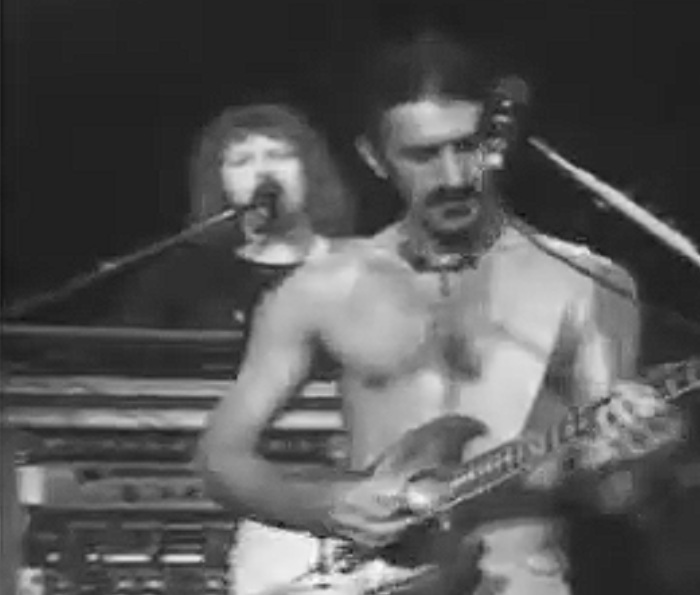
The "Halloween" audio DVD contains a video of "Suicide chump" as one of three extra tracks on it. It comes from a concert taped a month before, October 13, Passaic, New Jersey.
To the right a still from it with Denny Walley singing the lyrics.
During the 1978 tour the first songs turn up that would later land on "You are what you is" as studio recordings. On "Halloween '78" you can find "The meek shall
inherit nothing", "Conehead" and "Suicide chump". As usual these songs changed over time. In this case not drastically.
The "Halloween" audio DVD contains a video of "Suicide chump" as one of three extra tracks on it. It comes from a concert taped a month before, October 13, Passaic, New Jersey.
To the right a still from it with Denny Walley singing the lyrics.
Suicide chump (11-31-1978), 6:49-7:15 (midi file).
Suicide chump (11-31-1978), 6:49-7:15 (transcription).
See the You are what you is section for how the band played "Suicide chump" in 1981. The 1978 Halloween 5-CD version
contains two guitar solos, as also the Halloween DVD edition does. The first by Denny Walley following the blues scheme, the second by Zappa over a basic D pedal in 12/8. It's this pedal solo in D Mixolydian that forms the main difference with the 1981 versions. Specific for the 1978 5-CD version is the one and a half minute Zappa takes for introducing the song.
Bars 1-4 from the example above are from the transition from the sung part (that is a reprise of it halfway) towards Zappa's solo. The bass is playing the "come on and get it over with"
line in higher registers with Denny Walley improvising ad lib. From bar 5 onwards the bass is playing a D pedal. The other players are giving some harmonic fill-in
in the background, transcribed by approximation. Better audible is a sustained D during bars 7-8.
Packard goose (1978)
"Packard goose" as played in November 1978 has the same lyrics as on "Joe's garage" from 1979, including the line "Hey Joe, who did you blow?". This suggests
that the idea for the plot of "Joe's garage" already existed in 1978, at least some of its outlines.
Also as a composition this title remained unaltered. See "Packard goose (1979)" from the Joe's garage section for examples
from the 1979 version. So it's mostly the details and soloing that make the difference.
Packard goose, 3:01-3:53 (midi file).
Packard goose, 3:01-3:53 (transcription).
Another difference lies in the transition from the "Music is the best" section to the soloing. The "Music is the best" part has the melody from bars 1-4, staff 3, from
the example from above as a vamping figure. When the lyrics from this "Music is the best" part have ended, the 1979 version directly moves over to a new vamping
figure, used for the guitar solo. In 1978 this "Music is the best" melody gets maintained much longer. During bars 5-12 a guitar progression is played over it. From bar 13
onwards the bass plays the vamping figure for the solos, in 1978 taken care of by both L. Shankar on violin and Zappa on guitar. As you can see the first "Music is the best"
vamp keeps being played over the new bass vamp. When the soloing progresses the first vamp moves to the background, eventually disappearing. Regarding the meter the first
vamp notates better in 4/4, though the accompaniment is using many triplets. The second vamp has triplets on the first beat itself, so 12/8, 6/4, or two times 3/4, becomes a
more suitable meter for notating it. With the first vamp still continuing, I've notated all of the example from above in 4/4, but in the FZ Guitar guitar
book the solo part gets notated in 3/4. Harmonically you can see the A switching between natural and sharp every two bars during the whole example. Because of this, it can't be attributed
to one particular scale.
The story of Ms. X
During the 1978 fall tour Zappa met Warren Cuccurullo, who he had known since 1976 and who would become a band member the next year. He told Zappa a weird story about a woman he had met in New York,
calling herself Ms. X. They chatted for a while, exchanged phone numbers and eventually he visited her in her appartment. She took the initiative to have sex and only then Warren Cuccurullo found out that she was a she-male. Unable to deal with this, he felt forced to stop. Zappa liked this story that much that he invited him to recount it on stage too.
So it became a song of 8:12 minutes, with Warren Cuccurullo being responsible for the (spoken) text and Zappa for setting up some musical accompaniment and introducing the song.
The story of Ms. X, 1:13-1:22 (midi file).
The story of Ms. X, 6:08-6:13 (midi file).
The story of Ms. X, sections (transcription).
During the opening Zappa is asking his band to play a rock-type vamp for accompaniment. The first example from above it becomes, a vamp in 4/4, subdivided as 3+2+3.
The key is C Mixolydian. During much of the song the band is freely improvising, however. Another vamp turns up at 6:08, when the sexual encounter begins. It has an A bass pedal in 5/8, a figure The Mothers of Invention returned to frequently in the sixties when Zappa was hand-signalling the band to do so. At the start the keyboard players are playing a chromatic dissonant
progression over it, rhythmically irregular.
Muffin man (1978)
This song got often used as one of the closing numbers of a concert. "Muffin man (1975)" appeared first in this manner on
"Bongo fury" (see the corresponding section). There must be dozens of versions of Zappa playing a solo over the vamp of this song in the tape archive. The way
this vamp got played never really changed.
Muffin man (27-10-1978), 1:21-1:34 (midi file).
Muffin man (27-10-1978), 1:21-1:34 (transcription).
During the Halloween concerts of 1978 the band included Arthur Barrow as the new bass player, while Patrick O'Hearn had returned for the end of the fall tour to play bass as well.
Joe Travers comments: "their different styles complemented each other, with each player taking over during certain tunes or sections, or playing in harmony with each other".
Above you can see that the bass part is played via parallel fifths, probably with each player playing one line, rather than one player playing chords.
It's a smaller example of eight bars, taken from the first show on October 27th. In classical music till around 1900 parallel movements were about always played via thirds (or sixths). Seconds were seen as
too dissonant and fourths and fifths as too consonant, fifths even having the status of a mistake in case of chords progressions. Even today parallel fifths sound a bit unusual, but
Zappa loved their sound.
Lobster girl
"Lobster girl" is a track from the 1978 Halloween concerts, that is included on "YCDTOSA Vol. VI". It's a duet with Patrick O'Hearn on bass and Vinnie Colaiuta on drums,
with the example below being four bars taken from it. I've roughly transcribed the drum part, the actual variation in types of drums and cymbals is richer. Only
Patrick O'Hearn are Vinnie Colaiuta credited as musicians, though the other band members are sometimes audible too.
Lobster girl, 1:34-1:48 (midi file).
Lobster girl, 1:34-1:48 (transcription).
Much of "Lobster girl" is improvised, but I'm having the impression that part of it is rehearsed. Though the bars from above show odd subdivisions,
the parts follow each other very well, not just by ticking 16th notes. It has something of a theme, because bar 1 is getting varied upon in bar 3 and two more times
during the continuation of the track. As far as you can relate this section to a key, it would be E Dorian, with many chromatic elements.
Zappa co-credits himself as composer, next to Patrick O'Hearn and Vinnie Colaiuta.
The track by itself offers no possibility to discern what his contribution might have been. There are words to this track too, spoken by Patrick O'Hearn.